
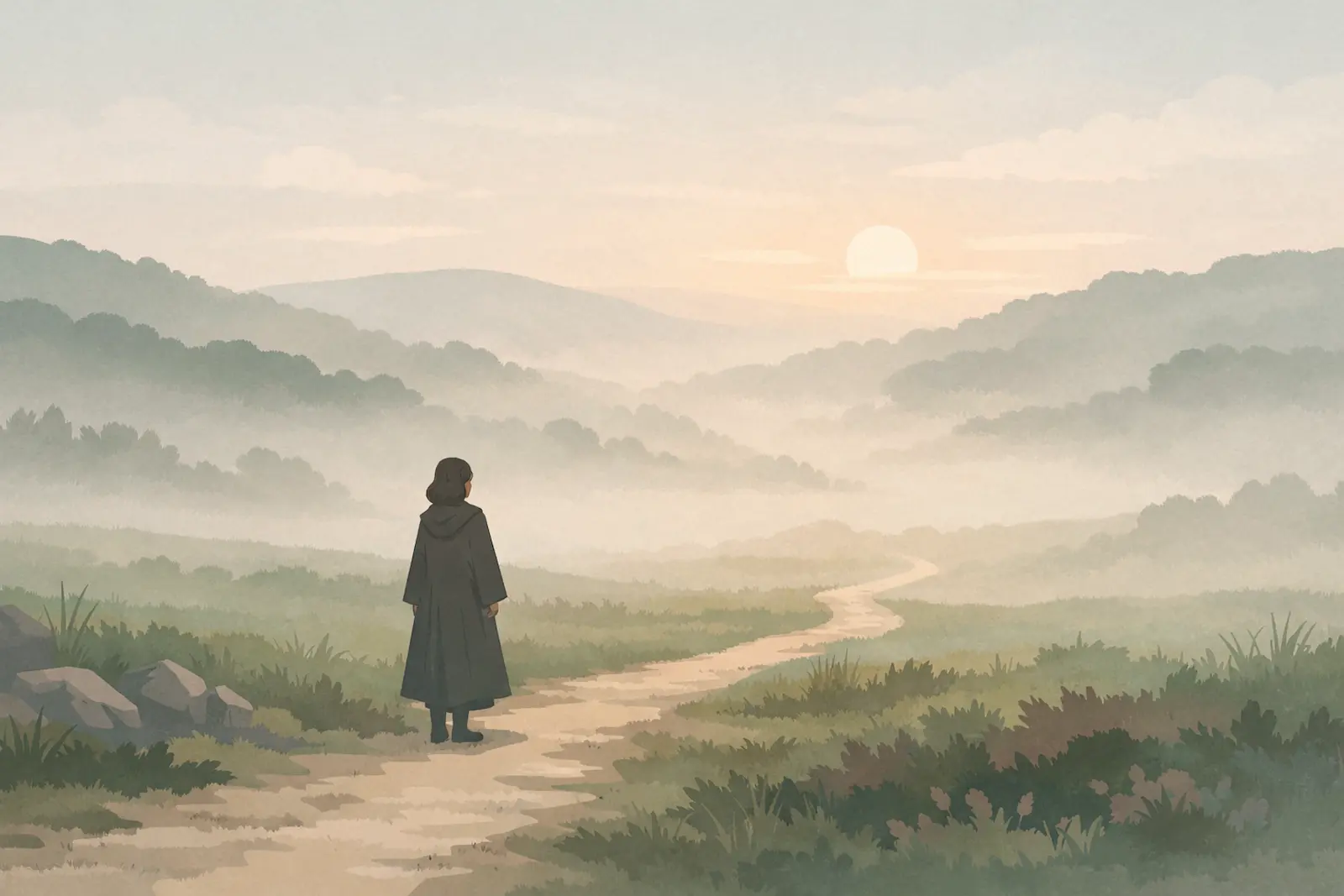
Picture yourself as a ten-year-old orphan living under the care of a resentful aunt.
Instead of treating you with compassion, she isolates you and allows your fourteen-year-old cousin to bully you mercilessly until one day he seriously injures you.
After years of oppression, you finally let him have it, telling him in no uncertain terms what you think of him. Any satisfaction you may have felt quickly dissipates when your aunt sentences you to a night all alone in a cold, eerily silent room.
Such is the story of Jane Eyre. Sadly, this is only one of many injustices she endures throughout her young life.
By the time Jane becomes an adult, she’s already experienced slander, public humiliation, and the loss of her closest friend.
Her formative years teach her how to build a life where—as she later reflects—“serene inward feelings bud and bloom” in the face of life’s uncertainties, and she learns how to extend the peace of her inner world to the people in her life—even those who once caused her harm.
She also develops the strength to hold firm to her integrity when pressured to do things that would undermine her self-respect.
Can you see yourself in Jane’s story?
Perhaps you bear emotional scars left behind by people in your past, or maybe a current relationship is disrupting your inner sense of calm.
In today’s post, we’ll examine how we can take cues from Jane Eyre to protect your inner peace by setting boundaries, reaching a state of emotional neutrality, and remaining in alignment with our personal values.
When Integrity Requires Distance
Many of us struggle to set healthy boundaries with others, and that’s often a result of growing up in environments where speaking up for our inner person meant isolation or physical abuse.
We might have a person in our life who disrupts the peace of our inner world, yet we quietly tolerate their hurtful or intrusive behavior to avoid hurting their feelings.
Still, it would be wise to pause and ask ourselves:
What do I stand to lose if I ignore the needs of my inner self?
Why do I feel the need to put this person’s sense of peace over my own?
For Jane Eyre, it’s her integrity and self-respect that are threatened when she is asked to make a choice out of alignment with her values.
At the age of nineteen, she finds herself “robed and veiled” standing before a priest and clerk. She’s just a few moments away from marrying her one true love—the wealthy and enigmatic Edward Rochester.
The ceremony takes an unexpected turn, however, when the priest gives them an opportunity to disclose “any impediment why ye may not lawfully be joined together in matrimony.”

Unfortunately for our heroine, there is an obstacle to this lawful union—Mr. Rochester is already married.
After being exposed at the altar, Edward explains that he was duped into marrying a woman with severe mental illness.
Though legally bound to his wife, he maintains that he’s deeply in love with Jane and asks her to be his mistress.
When she refuses, he pleads with her to reconsider. These pleas set off a struggle within Jane’s inner world.
She tells herself, “Think of his misery; think of his danger—look at his state when left alone; remember his headlong nature; consider the recklessness following on despair—soothe him; save him; love him; tell him you love him and will be his.”
Nonetheless, she refuses to put Edward’s grief over her personal values.
“I care for myself. The more solitary, the more friendless, the more unsustained I am, the more I will respect myself.”
To ensure her boundaries remain intact, Jane decides to flee the estate. This isn’t an act of punishment on her part. It’s a safeguard to keep her in alignment with her personal values.
Admittedly, it’s easy to understand why a person would go “no-contact” in an extreme situation like this.
It feels much harder to justify, though, when it’s a matter of someone repeatedly saying or doing things to cause us discomfort or emotional pain. Often, what we remove by reducing or severing contact is access to our emotions.
Someone who willfully hurts us hasn’t earned that privilege.

When Distance Isn’t Enough
Still, it isn’t enough to simply reduce contact with hurtful people. We need to reach a state of emotional neutrality toward them as well.
For those of us who lack self-trust, it can be difficult to name the emotional harm others cause us and remove them from our lives without getting angry or feeling utterly shattered.
The intensity of these feelings serves as an emotional splint—setting our boundaries firmly in place and holding them there.
Having broken a bone myself, I can tell you that splints play an important role in healing, but they also cause muscles to waste away in the process.
Similarly, harboring resentment fortifies us to keep our distance from the one causing us harm, but it erodes our sense of inner peace by allowing them to maintain indirect access to our emotions.
Jane learns this lesson through the many hardships and injustices she endures throughout her young life—drawing inspiration from her closest childhood friend.
After the confrontation with her cousin, she’s sent to the Lowood Institution—a charity school for orphaned girls.
There she observes the constant verbal abuse and physical cruelty inflicted on fourteen-year-old Helen Burns at the hands of their teacher, Miss Scatcherd. Jane marvels at her ability to endure beatings and public humiliation without crying or fighting back.
Over time, the two girls become close friends—bonding over their love of reading and shared experiences. Jane confides in Helen about the mistreatment she suffered while living with her aunt and cousin.

After listening carefully, Helen gently challenges her thinking on the matter.
“She has been unkind to you, no doubt; because you see, she dislikes your cast of character, as Miss Scatcherd does mine; but how minutely you remember all she has done and said to you! What a singularly deep impression her injustice seems to have made on your heart! No ill-usage so brands its record on my feelings. Would you not be happier if you tried to forget her severity, together with the passionate emotions it excited? Life appears to me too short to be spent in nursing animosity or registering wrongs.”
Helen doesn’t deny the harm caused by Jane’s aunt. Rather, she emphasizes the importance of letting go of resentment and avoiding rumination on past grievances—not to absolve Aunt Reed of her guilt but to bring peace to her inner world.
Jane takes Helen’s wise words to heart and eventually reaches a state of emotional neutrality toward the Reed family. The peace she’s spent years cultivating is tested years later when her dying aunt summons her for a visit and makes a stunning confession.
Three years prior, Aunt Reed had received a letter from Jane’s distant uncle inquiring of her whereabouts.
“Because I disliked you too fixedly and thoroughly ever to lend a hand in lifting you to prosperity. I could not forget your conduct to me, Jane—the fury with which you once turned on me…and I took my revenge: for you to be adopted by your uncle, and placed in a state of ease and comfort, was what I could not endure. I wrote to him; I said I was sorry for his disappointment, but Jane Eyre was dead: she had died of typhus fever at Lowood.”
This isn’t an attempt to reconcile. Aunt Reed simply wants to unburden her conscience before she dies and firmly rejects Jane until the end. Though her aunt doesn’t seek forgiveness, Jane offers it anyway.

“Love me, then, or hate me, as you will,” I said at last, “you have my full and free forgiveness: ask now for God’s, and be at peace.” Poor, suffering woman! it was too late for her to make now the effort to change her habitual frame of mind: living, she had ever hated me—dying, she must hate me still.”
Jane refuses to internalize her aunt’s hatred—choosing the path of peace and acceptance instead. Aunt Reed’s rejection says more about her own character than Jane’s. She remains miserable up to her last breath, and neither her daughters nor Jane shed a single tear.
Do you have an Aunt Reed in your life—someone who goes out of their way to dim your shine?
If so, know that your suffering is valid, and you don’t need anyone’s permission to protect yourself from further damage.
It’s understandable if you feel anger toward this person, and maybe you need it for a while to ground yourself in reality and keep your distance.
No one can tell you when it’s time to remove this emotional splint. You’re the only one who can determine when you feel strong enough to do it. The goal isn’t to forget the harm done or allow the person back into your life.
The goal is to reach a state of emotional neutrality, so the pain of their actions no longer robs you of inner peace.

When Peace Requires Integrity
Sometimes the issue in a relationship isn’t malicious emotional harm—it’s pressure to conform with things out of alignment with our personal values.
For example, in this month’s introductory post, I discussed a time when I compromised my integrity to fit in with people in my social circle. I’d allowed myself to get drawn into gossipy conversations, and it led me to not only believe a hurtful and unfounded rumor but repeat it as well.
Unfortunately, this absence of boundaries resulted in inner turmoil once I realized the harm I’d caused an innocent person.
We don’t always need to physically distance ourselves in these types of situations, but we do need to take a firm stand for what we believe is right.
Jane models this in how she handles an unsuitable marriage proposal.
After fleeing Mr. Rochester’s estate, she ends up on the doorstep of a clergyman named St. John Rivers. She hasn’t eaten in three days and has no shelter from the rain. Realizing the severity of her situation, he allows her to stay with him and his sisters.
Over the course of ten months, St. John observes Jane’s diligence, tact, and high intelligence, and it moves him to propose.
“God and nature intended you for a missionary’s wife. It is not personal, but mental endowments they have given you: you are formed for labour, not for love. A missionary’s wife you must—shall be. You shall be mine: I claim you—not for my pleasure, but for my Sovereign’s service.”
She refuses, knowing that “as his wife—at his side always, and always restrained, and always checked—forced to keep the fire of my nature continually low, to compel it to burn inwardly and never utter a cry, though the imprisoned flame consumed vital after vital—this would be unendurable.”

He tries to guilt her into marrying him, claiming, “…if you reject it, it is not me you deny, but God.”
Nonetheless, Jane finds the strength to assert her boundaries.
“It was my time to assume ascendency. My powers were in play and in force. I told [St. John] to forbear question or remark; I desired him to leave me: I must and would be alone. He obeyed at once. Where there is energy to command well enough, obedience never fails.”
In the end, the two are able to maintain “a regular, though not frequent, correspondence” with each other. It’s unlikely they’d have ended up at peace with each other if Jane had allowed herself to be talked into something that conflicted with the needs of her inner person.
Like Jane, we may find ourselves in situations where someone directly or indirectly asks us to give up parts of ourselves to fit their ideals. It can be challenging to stay true to ourselves when we fear backlash or abandonment.
However, fear doesn’t mean certainty. We won’t know how a person will react to a boundary until we communicate it clearly.
“Can we talk about something else? I’m really uncomfortable talking about people behind their back?”
True, they might bristle at it in the beginning, but they may just need time—and gentle reminders—to process and accept it.
Remaining in alignment with our values allows us to maintain the peace of our inner world while building relationships based on trust that others will accept us and honor our needs because they care about us.

Next Steps for Your Self-Discovery Journey
If you’d like to explore these ideas more personally, these resources may help.
If you’re ready to explore what peace looks like in your life right now, start with this Peace Readiness Toolkit. I designed it to help you understand how you experience peace, regulate your emotions, and stay aligned with your values in daily life.
Gentle Ways to Apply This:
- Examine how your relationships impact your inner world. If you find that your peace is being disturbed by someone in your life, reflect on what needs to be protected and if you need distance to restore your peace. This free printable, When Integrity Requires Distance, prompts you to explore when stepping back from someone becomes an act of self-respect.
- Notice how anger, grief, and resentment have protected you and consider whether or not they’re still serving you. Use this free gentle reflection, When Distance Isn’t Enough, to help you reach emotional neutrality and remove unhealthy access to your inner world.
- Explore how to remain present, honest, and self-respecting in situations where fear of backlash or abandonment makes integrity feel risky. This free worksheet When Peace Requires Integrity can help you recognize when inner peace depends on staying aligned with your values even when doing so feels uncomfortable.
Reading Recommendation
- Jane Eyre by Charlotte Brontë (This novel is in the public domain. I’m linking to a free, legal copy through Project Gutenberg so anyone can read along without barriers. You’re welcome to use any edition or format that works best for you.)
Protect Your Inner Peace: Distance Is Not the Destination
Though written nearly two centuries ago, Jane Eyre was ahead of its time in its examination of the roles boundaries, emotional neutrality, and integrity play in achieving and maintaining inner peace.
Sometimes protecting our peace means putting distance between ourselves and those who willfully overstep our boundaries—but minimizing contact isn’t always enough.
True inner peace requires emotional neutrality—not reconciliation or ignoring the harm that was done, but releasing the anger, grief, or resentment that once protected us.
It might feel intimidating to do these things at first, especially if you struggle with self-doubt. Still, you are no less deserving of inner peace than anyone else in your life.
Thank you for reading. If this post resonates with you, please share it with anyone who could use encouragement to do what’s necessary to protect their peace.
Do you notice any similarities between Jane’s journey and your own?
Please feel free to share your thoughts in the comments. If you’d like to receive an email notification when my next post goes live, you can subscribe using the form below.
Keep it kind, respectful, and focused on self-love and growth—let’s make this a safe, uplifting space. 🌿