

“The human world is a mess. Life under the sea is better than anything they got up there”
Sebastian—from Disney’s Little Mermaid—uttered these words to his charge Ariel over thirty-five years ago.
If he felt that way then, I can’t even imagine what he’d think about the state of the world today.
For one thing, international peace feels more elusive than ever. In fact, data collected by the Institute for Economics and Peace suggests that “the international order is approaching a tipping point.”
Trade wars, social unrest, and a historic increase in military spending worldwide contribute, in part, to rising global tension. Sadly, these are just a few of many factors.
Then, there’s the conflict that hits closer to home—things like mental illness and interpersonal issues.
In short, Sebastian had a point—the world indeed is a mess—and it’s enough to make me wish I had fins myself.

If you find yourself agreeing with me, you’ve come to the right place.
Instead of getting lost in things well beyond our control, we’re going to shift our focus to what we can control—our thoughts and actions.
We may not be able to achieve world peace, but we can use emotional regulation skills to find it within ourselves and maintain it with others—including strangers.
When we achieve peace within our inner world, we can respond to challenges in the outer world mindfully—not impulsively. This month we’ll explore ways we can work with our nervous system to do just that.
Unfortunately, common misconceptions make the concept of peace seem more like empty idealism than an achievable outcome.
Perhaps that’s true in a global sense, but it’s well within reach on a personal level. We just need to clarify what it looks like in practice.
To do that, we need to dismantle the myths.
Peace Is Built Through Regulation, Not the Absence of Conflict
People often confuse peace with the absence of conflict. This can be especially discouraging for people on a mental health journey because they may confuse moments of inner struggle with failure.
Progress is not linear. This may sound cliché, but the truth is that no human on this planet lives in perfect homeostasis. Things change for us constantly, making some seasons more challenging than others.
In his book The Upward Spiral, Dr. Alex Korb describes brain function as “a series of little computers connected to each other.” When one computer—or neural circuit—malfunctions, it can throw the others out of sync, causing depression or anxiety.
Many of these problems stem from environmental factors beyond our control, and they can make it harder for us to regulate our emotions.
For example, someone struggling to make ends meet in an unstable economy may experience chronic stress that disrupts how their brain produces and releases serotonin—the neurotransmitter that influences our motivation and mood.
Lower serotonin can also mean fewer building blocks for melatonin production—resulting in nonrestorative sleep or insomnia.
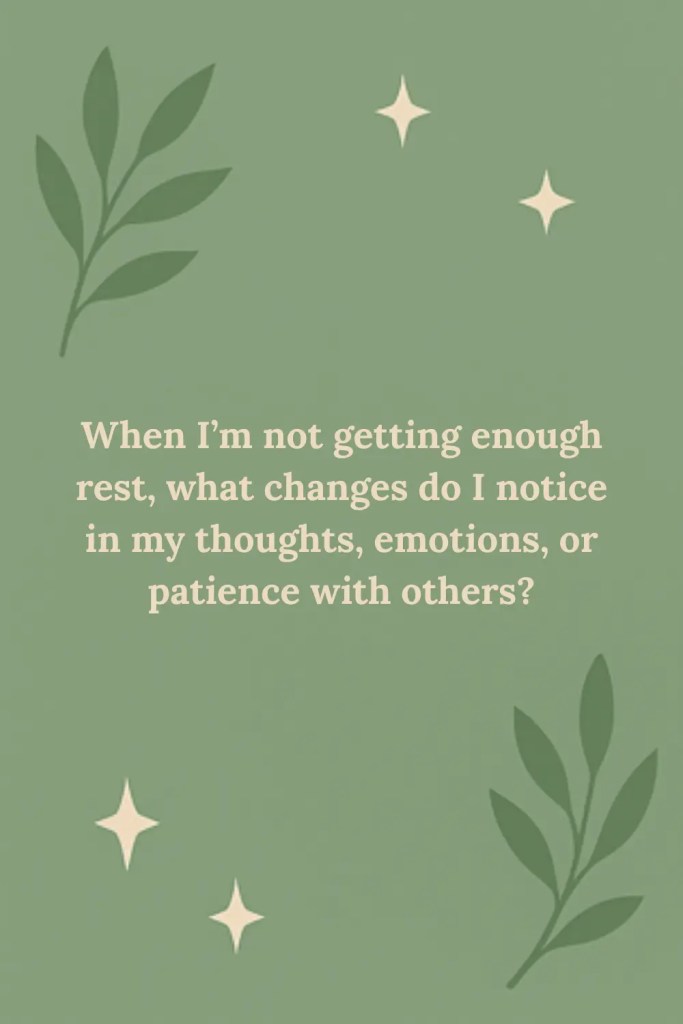
If you’ve taken care of a newborn or lived near noisy neighbors, you understand the connection between sleep deprivation and inner chaos.

Without proper sleep, we become irritable or easily overwhelmed, or we may struggle to concentrate on tasks and make mistakes that result in even more stress.
Does any of this mean that we’ve failed in our inner healing efforts?
Not at all.
It means we need to engage in productive conflict resolution with our nervous system. Put simply: we need mindfulness and rest.
That can be as simple as taking a slow-paced walk outside and tuning into the sounds of the environment—not music or a podcast. Research suggests that natural sunlight activates serotonin-related neural circuits that overlap with those targeted by antidepressants. Sunlight exposure also improves sleep quality by suppressing melatonin production during the day, which helps to regulate the circadian rhythm.
True, these things won’t necessarily eliminate the external stressors. Still, they can pause our body’s fight-or-flight response and help us regain mental and emotional clarity—making it easier for us to problem-solve.
Another way to support nervous system regulation is through mindful listening. Slow, calming music can help cue the body out of fight-or-flight and into a state of rest.
If you’d like to try this, take a moment to listen to Clair de Lune by Claude Debussy.
Peace Requires Boundaries, Not Silence
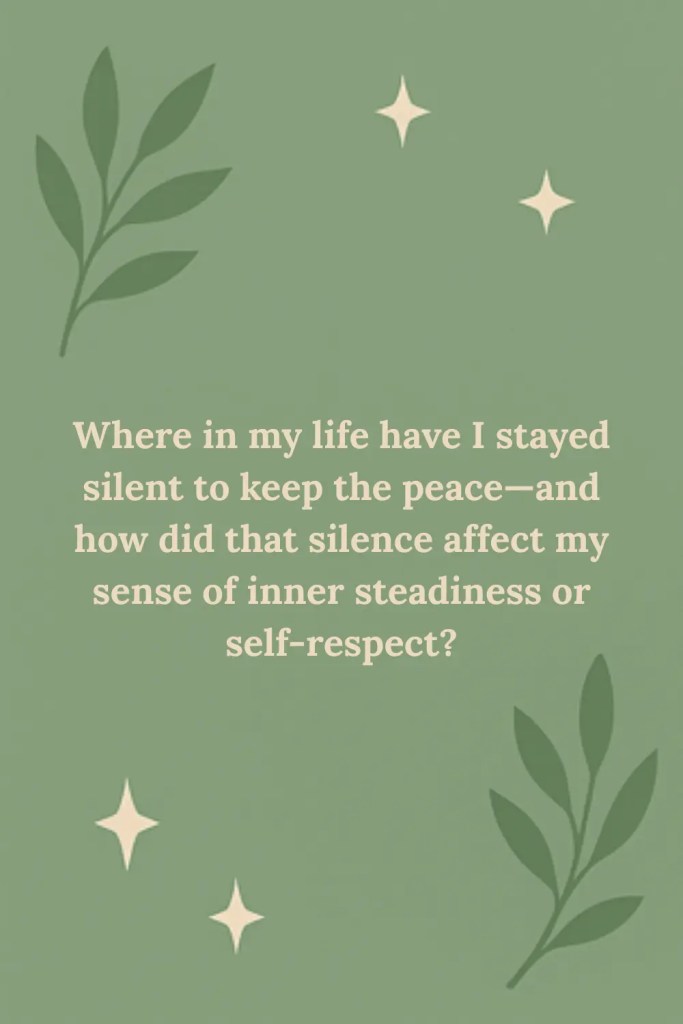
The idea that peace requires silence can make it difficult for people to set healthy boundaries with others because they worry that speaking up means disturbing the peace.
In my love cornerstone post, I talked about our inner person—the internal guardian of our true thoughts and emotions.
Sometimes in trying to keep the peace with others we set off a struggle with our inner self because we force them to hide away and make themselves smaller.
We essentially tell ourselves that who we are and how we really feel doesn’t matter.
Can you imagine telling your child to just be quiet and deal with it if they told you that someone’s actions made them uncomfortable?
Definitely not!
Parental instinct would move you to set a firm boundary by either addressing it directly or removing them from the situation completely. You would never expect them to suffer in silence because you’d want them to feel at peace.
Yet, we tend to struggle when it’s time to speak up for our inner child. This can leave us feeling conflicted, ashamed, or resentful.
I’ve learned this lesson the hard way.
Last year, I had to come clean about an awful rumor that I repeated in front of someone else. It had floated around for years.
The accusation just seemed out of character for this person based on my own experiences. Yet, fear of losing my place in the group kept me from taking a hard stand against the gossip.

Sadly, the more I listened to stories about this person, the easier it became to believe they were actually capable of doing something so egregious.
Eventually, I allowed myself to be persuaded and lost all respect for this person—so much that I felt justified making snarky comments about the situation in mixed company.
A few weeks later, I came across an article about the consequences of slander. It likened it to killing a person’s reputation which felt very sobering to me, and we don’t even have to start a rumor to assassinate someone’s character.
We can unintentionally slander someone by simply repeating an unsubstantiated accusation—even if we genuinely believe someone else’s lie.
This realization really troubled my conscience, and I knew I had to make things right. I needed to take responsibility for my part and sincerely apologize.
Telling someone what you said about them behind their back isn’t easy. Still, all of this turmoil could’ve been avoided if I had set a firm boundary and refused to participate in gossip in the first place.
Silence may seem like the best option to maintain peaceful relationships, but it could end up disrupting your inner peace.
Peace Isn’t Found in Having More
It’s easy to understand why it’s common for people to see money as a pathway to peace in the context of widespread economic turmoil.
Unaffordable healthcare, exorbitant housing costs, and inflation remain constant topics of discussion on social media—since so many of us are struggling to fill our basic needs.
Even still, we have to scroll past members of the wealthy class flaunting their privilege on our feeds.
Must be nice, right?
Last month I discussed the difference between inspirational and aspirational content. Wealth flexing falls under the latter.
Most of us find this content aspirational because we just want to know what it feels like to not have to worry about groceries, utilities, and insurance. These posts also show us what’s possible if we’re willing to hustle hard enough.
The more we take in aspirational content the easier it becomes to fall into this line of reasoning:
If I work more hours, I’ll land that promotion. I won’t have to stress my bills as much, and I’ll finally be able to buy a house in a safe neighborhood. I just need to grind hard now, then I’ll be able to rest and enjoy life later.
We’ve officially hit the start button on the hedonic treadmill.
I hope you stretched first because this could be a long run.

The hedonic treadmill—or hedonic adaptation—describes the human tendency to return to an emotional set point after experiencing a change in circumstance. We get the promotion, buy the house, and bask in our newfound financial security.
Over time, though, we start to realize that our car isn’t as nice as our neighbors’ fully loaded SUV. We buy a new car and settle in a bit—until our child tells us all about their friend’s trip to Disney World. They’re the only kid on the block who hasn’t gone yet.
You’d think the happiest place on Earth would be enough to hit the stop button.
Nope! The treadmill just keeps right on going.
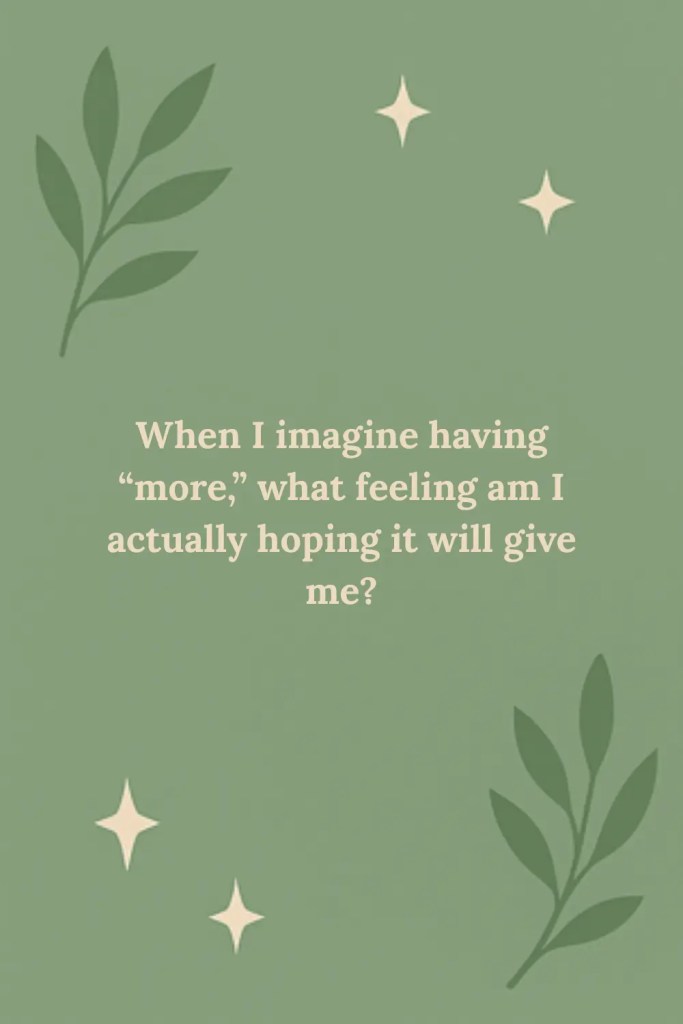
What started off as wanting enough just became a never-ending cycle of wanting more.
There’s nothing wrong with going for a promotion, buying a new house, or even going to Disney World. The problem comes in when our motivation comes from keeping up with others.
Go for the promotion, if it means having more breathing room in your budget. Don’t do it just to keep up with hustle culture, though, because the goalpost will only keep moving until you tire yourself out.
True peace often comes from being content with enough—not aspiring to have it all.
Next Steps for Your Self-Discovery Journey
If you’re ready to explore what peace looks like in your life right now, start with this Peace Readiness Toolkit. I designed it to help you understand how you experience peace, regulate your emotions, and stay aligned with your values in daily life.
Meaningful Actions to Try:
- Find small habits to incorporate into your routine to regulate your nervous system. This free printable, Small Habits for Nervous System Regulation, can help you notice what actually supports calm and steadiness in your body.
- Practice setting healthy boundaries with others. Use this free gentle reflection, Boundaries That Protect Peace, to find clarity and build up trust within yourself.
- Reflect on your ambitions and motivations to ensure you’re pursuing sustainable goals. This free worksheet Enough Without Exhaustion can help you explore the difference between pursuing what you need and chasing what keeps moving.
Reading Recommendation
- The Upward Spiral: Using Neuroscience to Reverse the Course of Depression, One Small Change at a Time by Alex Korb, PhD
Additional Inspiration:
Peace, Reconsidered
The myth that peace requires silence and complete stillness makes it seem unattainable. Fortunately, we’ve clarified that peace can exist despite the noisiness of the world.
Though we can’t insulate ourselves from hardship, we can steady ourselves to face challenges by learning to regulate our nervous system. Small daily habits like gentle walks in the sunshine and moments of rest can stabilize us and help us regain the mental and emotional clarity we need to problem-solve.
No one is perfect, so there will be times when someone says or does something that disrupts our inner peace. Nonetheless, we don’t need to keep silent to maintain peace with others. In fact, speaking up and enforcing boundaries keeps us steady by helping us remain in alignment with our values.
Now that we’ve cleared up these misconceptions, let’s make it our goal for this month to tune into the things that support our peace and minimize the things that disrupt it. We may not be able to solve the world’s conflicts, but we can learn to navigate our own in ways that nurture, not harm.
Thank you for being here with me! I’m so grateful to have a community of fellow travelers, and I look forward to learning from you in the comments. Tell me all about the things that help you find calm in uncertain times. I’d especially love to hear about how you navigate boundaries with the people in your life.
If you’d like to be notified when the next post goes live, you can subscribe using the form below.
Coming Up:
Reassurance Before Resolution: Why Inner Peace Starts With the Nervous System (02/08/2026)
Distance Is Not the Destination: What Jane Eyre Teaches Us About Boundaries, Neutrality, and Integrity (02/15/2026)
Why Inner Peace Feels So Hard Right Now: And What the Nervous System Has to Do With It (02/22/2026)
Keep it kind, respectful, and focused on self-love and growth—let’s make this a safe, uplifting space. 🌿